From Elementor Rescue to Astro: Rebuilding NovaPera on a Modern Stack
About the Project
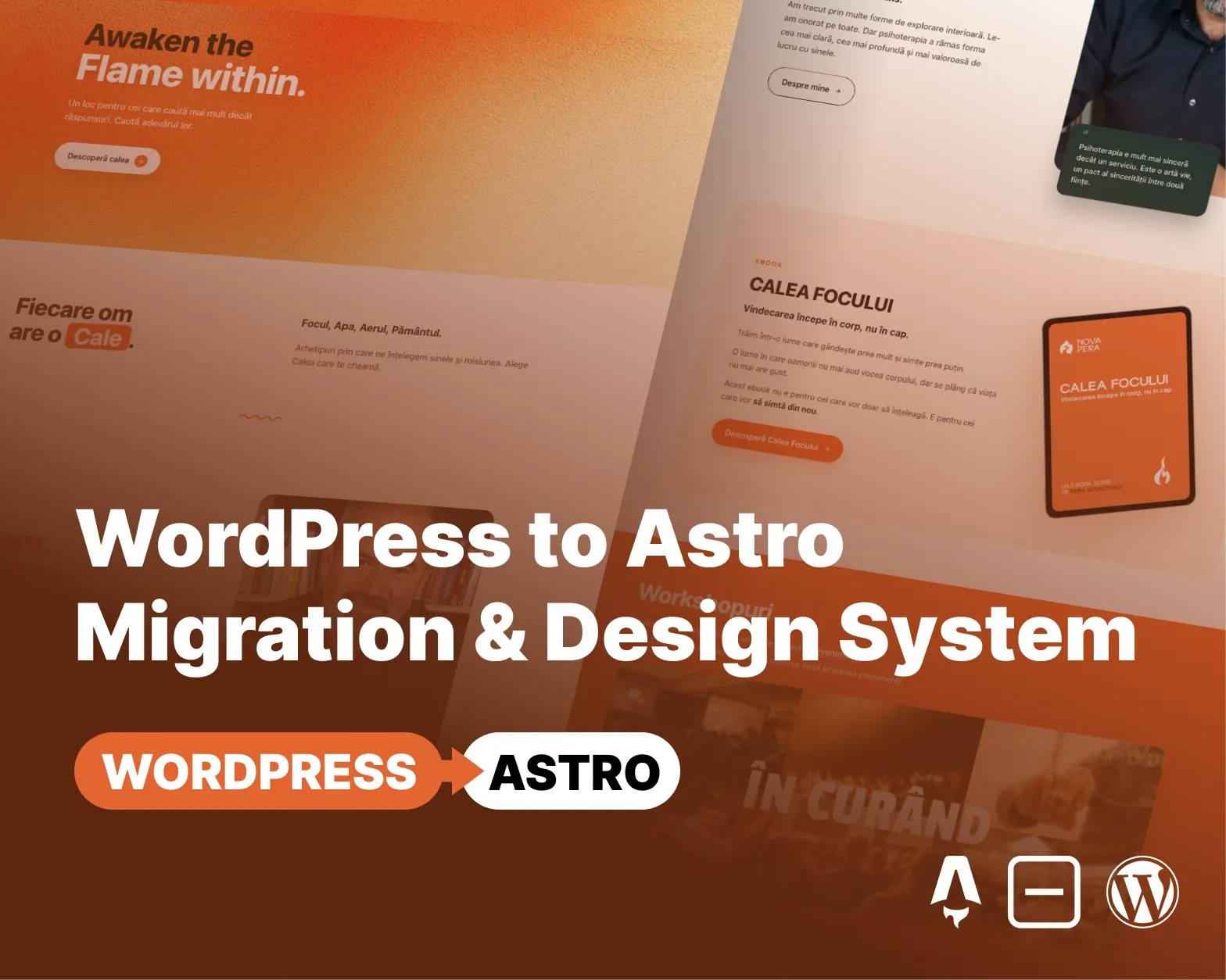
A two-phase project: rescuing a broken Elementor build, then migrating NovaPera onto Astro and EmDash CMS — a design system and an AI-ready content workflow.
Tech Stack
Client: NovaPera
Industry: Mental Health, Education & Personal Branding
Services: Platform Migration, Frontend Architecture, Design System, UI/UX Design, AI-Assisted Content Workflow, SEO
This project ran in two distinct phases. It began as a rescue operation: a WordPress site built in Elementor whose layouts collapsed across breakpoints and whose styling had no shared rules. I audited the interface, rebuilt the broken containers and standardized the layout until it rendered correctly on every device.
That work bought the site stability — but it also made the real problem obvious. The platform itself was the ceiling. So the second phase was a full migration: NovaPera was rebuilt from the ground up on Astro with EmDash CMS, running on Cloudflare's serverless infrastructure, together with a new design system that finally made consistency a property of the codebase instead of a manual discipline.
The Client & Context
NovaPera represents the professional brand of a distinguished psychotherapist, author and educator recognized nationwide. In mental health and education, trust and authority are everything — the digital presence has to carry the same standard as the work behind it.
The goal was never just "a working website": it was a platform that reads as credible, loads instantly for a large audience, and can be updated without technical anxiety.
Phase One: The Elementor Rescue
I took over a WordPress site built with Elementor that was failing in ways visitors could see:
- Broken Layouts: Page structures lost alignment and collapsed entirely at certain screen resolutions.
- Responsive Failures: Tablet and mobile views suffered from content overlap, making text unreadable and navigation frustrating.
- Inconsistent Styling: With no global design rules, spacing and typography drifted from page to page and the visual hierarchy fell apart.
The intervention was deliberate and surgical:
- Elementor Structure Overhaul: I restructured the problematic containers and sections causing the breaking points, cleaning up the DOM along the way.
- Precision Spacing & Typography: Global and local spacing corrected by hand, typography standardized against the brand's guidelines.
- Custom CSS Integration: Where Elementor's native controls couldn't reach pixel-perfect accuracy, custom CSS forced the correct behavior.
- Visual Asset Creation: I designed and integrated custom imagery tailored to the specific context of the client's content.
- Responsive Recovery: Breakpoints and scaling logic redefined, eliminating overlap and letting elements adapt fluidly to any viewport.
The result was a site that rendered correctly everywhere and looked like the brand it represented. It worked. It just couldn't get better than that.
Why Repair Wasn't the Endgame
A rescue fixes symptoms. It doesn't change what produces them.
The constraint was never PHP as a language — modern PHP is fast and perfectly capable. The constraint was the model: a page builder that stores presentation as deeply nested markup, a theme and plugin stack where every visitor request triggers database queries and server-side rendering, and a styling layer where "consistent" depends on someone remembering to set the same value again.
That model has three practical consequences:
- Compounding Weight: Every builder widget adds markup, CSS and JavaScript that ship to the visitor whether the page uses them or not.
- Fragile Consistency: Design decisions live inside individual widget settings, not in one shared source of truth. Nothing prevents the next edit from breaking the system.
- Maintenance Surface: Plugins, themes and core updates each carry compatibility and security risk — and each update is a chance for a layout to break again.
For a brand whose credibility is the product, "stable for now" wasn't a good enough position to stay in.
Phase Two: The Migration to Astro & EmDash CMS
The rebuild targeted a stack where performance and consistency are structural, not something you maintain by hand.
- Astro: Renders pages to static HTML by default and ships zero JavaScript unless a component explicitly needs it. Interactivity is opted into per island, not paid for globally. For a content-led site — articles, courses, presentation pages — this is close to an ideal match: the visitor downloads a document, not an application.
- EmDash CMS: An open-source, full-stack CMS built on Astro and Cloudflare, with a familiar admin panel, a media library, authentication and a content model defined through the UI. It gives the client the WordPress-like editing experience they already know, without inheriting the WordPress runtime.
- Cloudflare: Provides the runtime — Workers for execution at the edge, D1 for the content database, R2 for media. Pages are served from locations close to the visitor instead of a single origin server.
The Migration in Practice
- Content Model First: Before moving a single page, I mapped the existing content into typed collections — pages, articles and the supporting content types — so structure came from a schema rather than from whatever a builder happened to produce.
- Rebuild, Not Export: Elementor markup wasn't converted; it was replaced. Every template was rewritten as clean, semantic Astro components.
- Media Migration: Assets were moved to R2, re-encoded to modern formats and served through responsive image handling.
- URL Preservation: Existing URLs were kept, with 301 redirects wherever a path had to change, so no accumulated SEO value was lost.
- Integrations Rewired: Forms, tracking and third-party integrations were reconnected to the new stack and verified end to end before cutover.
- Controlled Cutover: The rebuild was validated on a staging domain, then switched over with DNS, with the old install kept available as a rollback path.
The Design System
The migration was also the moment to stop treating consistency as a habit and start treating it as infrastructure.
- Design Tokens: Color, typography, spacing, radii, shadows and breakpoints are defined once as tokens and consumed everywhere. Changing a brand value is now one edit, not a search across pages.
- A Real Type Scale: Headings, body copy and supporting text follow a defined hierarchy, with line-height and measure tuned for long-form reading — which matters on a site built around articles and educational content.
- A Spacing System: Vertical rhythm follows a fixed scale, so sections relate to each other predictably instead of being nudged into place page by page.
- Component Library: Hero sections, cards, article layouts, CTAs and navigation are reusable components with defined variants. A new page assembles from existing parts and inherits the system automatically.
- Accessibility Built In: Semantic markup, contrast checked for readability, visible focus states, keyboard-navigable interface, and images with meaningful alt text.
- Responsive by Construction: Layouts are fluid by default rather than a set of desktop designs patched at three breakpoints — precisely the failure mode Phase One had to repair.
The UI/UX work went with it: clearer information architecture, tightened navigation, a more deliberate reading flow on article pages, and stronger visual hierarchy around the actions that matter.
Content Operations: A Stack That Works With AI
One of the clearest gains from the migration is one that doesn't show up in a screenshot: content is now dramatically easier to create and modify with LLM assistance.
The reason is structural. In the Elementor build, a page was serialized builder data — deeply nested layout objects with content buried inside them. That format is effectively opaque: an AI model can't reliably read it, and it certainly can't safely write it. Every change had to go through the builder UI by hand.
After the migration, that changed on three levels:
- Content Is Structured Data: Entries live in typed collections with real fields — title, body, metadata — separated from presentation. A model can read a collection, draft a new entry, or rewrite an existing one, and the output slots straight into the site without touching layout.
- Templates Are Readable Code: Pages are semantic Astro components in a Git repository. A new section or an entire landing page can be generated from a prompt with a coding agent, reviewed as a diff, and reverted in one command if it isn't right. Nothing about that workflow was possible on the old stack.
- The Design System Is the Guardrail: Because spacing, typography and color come from tokens and existing components, AI-generated output inherits the brand rather than inventing its own. The system constrains the model — which is exactly what makes the speed safe.
In practice this collapsed the cost of publishing. Drafting an article, producing metadata and alt text, spinning up a new page variant or restructuring an existing one went from manual builder assembly to a short review loop. The client gets more content, published faster, without the visual drift that usually comes with moving fast.
The Results & Impact
- Performance as a Property of the Architecture: Pages are pre-rendered to static HTML, ship no JavaScript unless a component needs it, and are served from the edge. Speed is no longer something to reclaim after the fact — there is no plugin stack, no builder payload and no per-request rendering to recover from.
- Consistency by Default: Design decisions live in tokens and components, so new pages inherit the system instead of re-implementing it. Visual drift stopped being a maintenance task.
- A Smaller Attack and Maintenance Surface: No plugin stack to patch, no theme-versus-plugin conflicts, no builder update that silently rearranges a layout.
- Predictable Cost: Serving pre-rendered pages from the edge removes the traditional hosting and server-load equation entirely.
- Editing Without Fear: The client edits content through an admin panel that behaves like the one they knew — but a bad edit can no longer break a layout, because layout isn't stored in the content.
- Content That Scales With AI: Creating and updating content is now a short, assisted review loop instead of manual assembly, with the design system keeping every output on brand.
- SEO Preserved and Improved: URLs carried over intact, with faster loads and cleaner semantic markup on top — and metadata now generated from the content model instead of maintained by hand, page by page.
Reflection
The two phases are worth reading together. The first proved that a broken build can be repaired to a genuinely high standard. The second proved that repair has a ceiling — and that at some point the honest recommendation to a client is not "let me fix this again", but "let's move to something that won't need fixing in the same way".