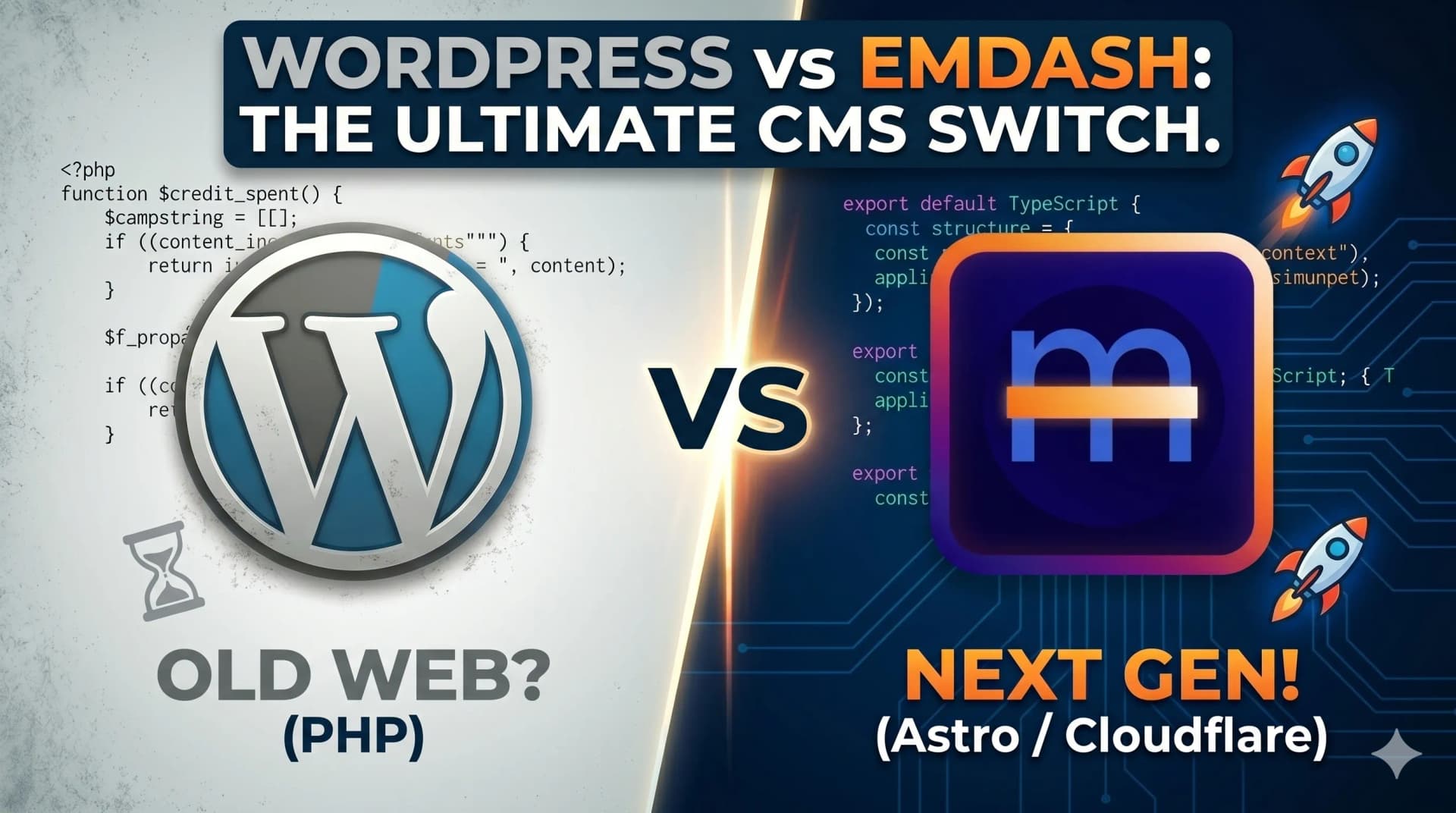
WordPress vs EmDash: Why Cloudflare's New CMS Made Me Ditch PHP After 7 Years
 Tiberiu Gabriel
For the past seven years, I have breathed, lived, and bled WordPress. I have built countless sites, debugged rogue plugins at 2 AM, and optimized PHP memory limits until my eyes literally hurt. But this month, the entire web development game changed. Cloudflare just dropped EmDash CMS, and it is sending massive shockwaves through the industry.
Today, we are doing a deep dive into WordPress vs EmDash. I will explain exactly what this new system is, why WordPress is finally showing its age, and why I believe EmDash is the ultimate WordPress alternative for modern web performance and SEO.
What is EmDash CMS?
Released in April 2026, EmDash is Cloudflare's brand new open source content management system. Cloudflare officially calls it the "spiritual successor to WordPress", and they are absolutely not kidding.
Instead of relying on decades old PHP, EmDash is a full stack TypeScript CMS built natively on top of the Astro web framework. Out of the box, it runs directly on Cloudflare Workers, utilizing D1 for the database and R2 for storage to give you blazing fast, serverless edge performance. But here is the best part: it does not lock you into Cloudflare. If you prefer traditional self hosting, you can deploy EmDash on any standard Node.js server, using SQLite for the database and a local file store. Whether you run it at the edge or on your own VPS, it is incredibly fast and entirely built from the ground up for the modern, AI driven web.
Why WordPress is Showing Its Age
Look, WordPress democratized the internet. We all owe it a massive debt of gratitude. But from a technical standpoint, WordPress is aging rapidly, and its legacy architecture is holding modern websites back.
First, the performance is fundamentally bottlenecked. Every time a user visits an unoptimized WordPress site, the server has to process bulky PHP scripts and query a massive MySQL database. You end up with bloated wp_options tables where every deleted plugin leaves behind garbage data. This destroys your Time to First Byte (TTFB) and tanks your core web vitals, which directly hurts your SEO.
Second, the security model is heavily flawed. In WordPress, a single badly coded plugin has full access to your entire site and database. We have all seen the weekly security bulletins about critical vulnerabilities in popular plugins. The core architecture simply trusts everything by default. EmDash takes a completely different, much smarter approach.
EmDash vs WordPress: The Ultimate Comparison
To give you a clear picture of how these two stack up, I put together a quick comparison of the pros and cons.
Feature | WordPress | EmDash CMS |
Core Technology | PHP and MySQL | TypeScript and Astro |
Hosting Environment | Traditional LAMP servers | Cloudflare Edge (Workers, D1, R2) or Node.js (SQLite + local file storage) |
Plugin Security | Broad trust (high risk of exploits) | Sandboxed Worker isolates (highly secure) |
Content Format | Raw HTML rendering (HTML soup) | Portable Text (Structured JSON) |
Performance (SEO) | Requires heavy caching for speed | Blazing fast serverless edge delivery |
AI Integration | Requires clunky third party plugins | Native AI agent support and MCP server |
Learning Curve | Very low for absolute beginners | Requires TypeScript and CLI knowledge |
What Else Makes EmDash Superior?
EmDash fixes the exact headaches that developers and technical SEO experts like me have been complaining about for years.
Sandboxed Plugins
This is the absolute killer feature. EmDash runs plugins in isolated sandboxes using Cloudflare Workers. If a plugin goes rogue or contains a vulnerability, it cannot take down your entire CMS or steal your database information. You grant plugins explicit capabilities instead of blind trust.
Built for AI and Automation
We are in 2026, and your CMS needs to talk to AI. EmDash ships with a built in MCP (Model Context Protocol) server. This means AI tools like Claude or custom OpenAI agents can interact directly with your site safely. It even includes an x402 micropayment model, opening the door for direct machine to machine content monetization.
Structured Content for Omnichannel
Instead of dumping messy HTML into a database, EmDash uses Portable Text. Your content is saved as clean, structured JSON. If you want to push that same article to a website, a mobile app, and an email newsletter all at once, you can do it flawlessly without stripping out broken formatting tags.
My Next Chapter: Why I Am Making the Switch
After seven incredible years in the WordPress trenches, I am officially calling it. I am moving my entire personal and professional operation over to EmDash.
Yes, the transition requires adjusting to a TypeScript workflow and learning the command line interface, but the benefits are impossible to ignore. The performance gains alone will drastically improve SEO rankings, and the security peace of mind is completely priceless. I am 100% bought into the Cloudflare ecosystem.
Starting this month, my focus is shifting entirely away from PHP and moving toward developing themes and plugins for the EmDash platform. The ecosystem is still in its early days right now. That means there is a massive opportunity to build the exact tools that the next generation of the web will rely on. WordPress had a beautiful run, but EmDash is undeniably the future.
Note: Parts of this article were generated with AI assistance, though I guided the direction and checked the main facts. AI can still make mistakes, so always double check the official docs!